


An unbiased estimator is an estimator whose expected value is equal to the true value of the population parameter being estimated. Unbiasedness is one of the most important finite-sample properties used to evaluate statistical estimators.
It indicates that an estimation procedure does not systematically overestimate or underestimate the unknown parameter. However, unbiasedness does not mean that an estimate obtained from every individual sample will be exactly equal to the true parameter value.
Definition of an Unbiased Estimator
Let  be an unknown population parameter and let
  be an estimator of . The estimator
  is said to be an unbiased estimator of if

for every possible value of in the parameter space.
The notation  emphasizes that the expectation is calculated under the probability distribution determined by the parameter .
If repeated random samples of the same size are drawn from the population and is calculated from each sample, the average of all the resulting estimates will approach the true value .
Bias of an Estimator
The bias of an estimator for the parameter is defined as

Therefore, is unbiased for when

The following cases are possible:
- If
 , then is unbiased.
 - If , then has positive bias and tends to overestimate .
- If , then has negative bias and tends to underestimate .
 , then
  , then
 Example: Sample Mean as an Unbiased Estimator
Let  be a random sample from a population having mean
  and variance
  . The sample mean is

Taking expectation and using the linearity of expectation,


Since  for every
  ,
,

Thus,

Therefore, the sample mean  is an unbiased estimator of the population mean .
Example: Sample Proportion
Suppose  is the number of successes in
  independent Bernoulli trials, each having probability of success
  . Then

The sample proportion is

Since  ,
,


Hence,  is an unbiased estimator of the population proportion .
Example: Unbiased Estimation of Population Variance
Consider the estimator

Its expected value is

Since this is not equal to , the estimator  is biased. Its bias is


An unbiased estimator of the population variance is obtained by replacing in the denominator with  :
:

For this estimator,

Therefore,  is an unbiased estimator of .
Example: Correcting a Biased Estimator
Let be a random sample from the uniform distribution on  , and let

The expected value of the sample maximum is

Thus,  is a biased estimator of . Multiplying it by
  gives
gives

Now,


Therefore,  is an unbiased estimator of .
Properties of Unbiased Estimators
1. Unbiasedness Is Defined with Respect to a Parameter
An estimator is not simply called unbiased without specifying the quantity it estimates. An estimator may be unbiased for one function of a parameter but biased for another function.
For example, if is unbiased for , then

However, this does not necessarily mean that  is unbiased for
  .
.
2. An Unbiased Estimator Need Not Be Unique
There may be several unbiased estimators of the same parameter. For example, if are identically distributed with mean , then each individual observation  is unbiased for .
Also, the sample mean is unbiased for . Therefore, both  and are unbiased estimators of , although their variances are generally different.
3. Linear Transformation Property
If is an unbiased estimator of , then for constants  and
and  , the estimator
  is unbiased for
  .
.
Since

and ,

Thus, is unbiased for .
4. Linear Combination of Unbiased Estimators
Suppose  are unbiased estimators of
  , respectively. For constants
  ,
,


Therefore,

is an unbiased estimator of

In particular, if are all unbiased for the same parameter and

then
is also unbiased for .
5. Nonlinear Transformations Do Not Generally Preserve Unbiasedness
If is unbiased for , then  is not necessarily unbiased for
  . In general,
![E[g(T)]\neq g[E(T)]](https://joborblog.com/wp-content/ql-cache/quicklatex.com-71801fe03e4dde09a6c56fdff9572e7b_l3.png "Rendered by QuickLaTeX.com")
For example, if is unbiased for , then
But
![E(T^2)=\operatorname{Var}(T)+[E(T)]^2](https://joborblog.com/wp-content/ql-cache/quicklatex.com-afa5db1526c3b7aa21150ce25864a318_l3.png "Rendered by QuickLaTeX.com")

Therefore, unless  ,
,

Hence, is generally not an unbiased estimator of .
6. Unbiasedness Does Not Guarantee Minimum Variance
Two estimators may both be unbiased for the same parameter but may have different variances. The estimator with the smaller variance gives estimates that are more concentrated around the true parameter value.
Suppose  and
and  are unbiased for . If

then is considered more efficient than .
7. Unbiasedness Does Not Guarantee Consistency
An estimator can be unbiased for every sample size and still fail to be consistent. Consistency requires the estimator to converge in probability to the true parameter as the sample size increases:

An unbiased estimator  will be consistent if its variance approaches zero:

Therefore, unbiasedness alone is not sufficient for consistency.
8. A Biased Estimator Can Be Consistent
An estimator may be biased for every finite sample size but still be consistent if its bias and variance both approach zero as the sample size increases.
For example,
has bias

Since

as  , the estimator is asymptotically unbiased and consistent under standard conditions.
9. Unbiasedness and Mean Squared Error
The mean squared error of an estimator is
![\operatorname{MSE}(T)=E\left[(T-\theta)^2\right]](https://joborblog.com/wp-content/ql-cache/quicklatex.com-bd32b09f34790969a2382471ad1e68b3_l3.png "Rendered by QuickLaTeX.com")
It can be decomposed as
![\operatorname{MSE}(T)=\operatorname{Var}(T)+[\operatorname{Bias}(T)]^2](https://joborblog.com/wp-content/ql-cache/quicklatex.com-2fd2b0257cb67ba50979af5863c97579_l3.png "Rendered by QuickLaTeX.com")
If is unbiased, then

and therefore,

Thus, among unbiased estimators, minimizing the mean squared error is equivalent to minimizing the variance.
10. Unbiasedness Is a Finite-Sample Property
Unbiasedness is usually examined for a fixed sample size. If

for every , then is unbiased for every sample size.
By contrast, asymptotic unbiasedness only requires

An asymptotically unbiased estimator may remain biased for every finite value of .
11. Unbiased Estimators May Not Exist
For some statistical models and some functions of parameters, no unbiased estimator exists. The existence of an unbiased estimator depends on the sampling distribution and the function of the parameter being estimated.
Therefore, it should not be assumed that every parameter automatically has an unbiased estimator.
12. Rao-Blackwell Improvement Property
Suppose is an unbiased estimator of and  is a sufficient statistic for . Define

Then  is also unbiased for , because
![E(T^*)=E[E(T\mid S)]=E(T)=\theta](https://joborblog.com/wp-content/ql-cache/quicklatex.com-7a974eea3120284c783bb73ac3bd1f04_l3.png "Rendered by QuickLaTeX.com")
Moreover,

Thus, conditioning an unbiased estimator on a sufficient statistic produces an unbiased estimator with variance no greater than that of the original estimator.
13. Completeness and Uniqueness of an Unbiased Estimator
If is a complete sufficient statistic for , then any unbiased estimator that is a function of is unique almost surely.
This result is a consequence of the Lehmann-Scheffe theorem. It also implies that such an estimator is the uniformly minimum variance unbiased estimator of the parameter.
Minimum Variance Unbiased Estimator
An estimator is called a minimum variance unbiased estimator of if it satisfies the following conditions:
- is unbiased for .
- Its variance is less than or equal to the variance of every other unbiased estimator of .
If the variance is minimum for every possible value of , then is called a uniformly minimum variance unbiased estimator, abbreviated as UMVUE.
Formally, an unbiased estimator is a UMVUE of if

for every unbiased estimator of and for every value of .
Unbiasedness and Efficiency
Suppose and are two unbiased estimators of the same parameter . Their relative efficiency may be defined as

If

then has a smaller variance and is more efficient than .
Unbiasedness Versus Consistency
| Unbiasedness | Consistency |
|---|---|
| It requires . |
It requires . |
| It is generally a finite-sample property. | It is a large-sample property. |
| It concerns the average value of the estimator. | It concerns convergence to the true parameter. |
| An unbiased estimator need not be consistent. | A consistent estimator need not be unbiased for finite samples. |
Unbiasedness Versus Sufficiency
Unbiasedness and sufficiency describe different features of an estimator or statistic.
- Unbiasedness concerns whether the expected value equals the parameter.
- Sufficiency concerns whether a statistic contains all the sample information about the parameter.
An unbiased estimator need not be sufficient, and a sufficient statistic need not be an unbiased estimator of a particular parameter. However, sufficient statistics are useful for improving unbiased estimators through the Rao-Blackwell theorem.
Is an Unbiased Estimator Always the Best Estimator?
An unbiased estimator is not necessarily the best estimator in every practical situation. It may have a very large variance and produce highly unstable estimates.
A slightly biased estimator may have a much smaller variance. Since
a biased estimator can have a smaller mean squared error than an unbiased estimator if the reduction in variance is sufficiently large.
Therefore, unbiasedness should be considered together with variance, mean squared error, consistency, efficiency and sufficiency when evaluating an estimator.
How to Find an Unbiased Estimator
A general procedure for finding an unbiased estimator is:
- Choose a statistic that depends only on the sample observations.
- Calculate its expected value .
- Express in terms of the unknown parameter.
- Modify , if necessary, so that its expected value equals the required parameter.
 .
.For example, suppose

where  and and are known constants. Define

Then


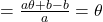
Therefore, is an unbiased estimator of .
Important Points to Remember
- An estimator is unbiased for if .
- The bias of an estimator is .
- Unbiasedness means correctness on average over repeated samples.
- An unbiased estimator does not necessarily give the true parameter value for every sample.
- More than one unbiased estimator may exist for the same parameter.
- A linear combination of unbiased estimators is unbiased for the corresponding linear combination of parameters.
- Nonlinear transformations do not generally preserve unbiasedness.
- An unbiased estimator may have a large variance.
- Among unbiased estimators, the one with the smallest variance is preferred.
- Unbiasedness does not automatically imply consistency, efficiency or sufficiency.
- A biased estimator may have a smaller mean squared error than an unbiased estimator.
- A function of a complete sufficient statistic that is unbiased is the unique UMVUE.
 .
.Conclusion
An unbiased estimator is an estimator whose expected value equals the true population parameter. It provides a procedure that is correct on average over repeated sampling. Common examples include the sample mean as an estimator of the population mean, the sample proportion as an estimator of a population proportion and the corrected sample variance as an estimator of the population variance.
Although unbiasedness is an important and desirable property, it is not sufficient by itself to identify the best estimator. The variance, mean squared error, consistency, efficiency and sufficiency of the estimator should also be considered.
An unbiased estimator does not guarantee a perfect estimate from every sample; it guarantees that the estimation method is correct on average.